
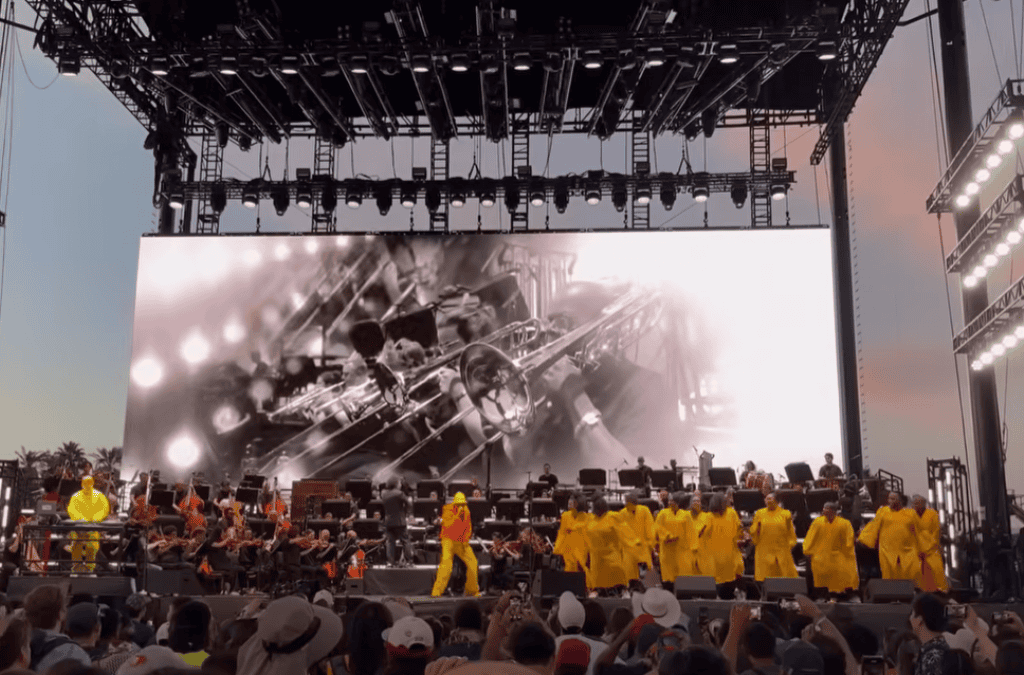
Every audience loves an orchestra!
Karen Garrity Music had the opportunity to contribute to Harry Levin’s article “Orchestras Are Stealing the Spotlight at Coachella” – it’s a great read. https://hmc.chartmetric.com/coachella-2025-la-philharmonic-orchestra/. The article made me think about the future of music.
Music has always been a reflection of cultural shifts, evolving in tandem with the tastes and expectations of audiences. While orchestras have historically been associated with grand concert halls and classical compositions, their presence in contemporary music is proving that symphonic arrangements are not just timeless—they’re transformative.
At Coachella 2025, the Los Angeles Philharmonic took the stage in a groundbreaking performance alongside Dave Grohl, Laufey, LL Cool J, Zedd, CA7RIEL, Paco Amoroso, Natasha Bedingfield, Cynthia Erivo, and others. This wasn’t just a novelty—it was a statement. The fusion of classical instrumentation with jazz, hip-hop, and electronic music demonstrated that orchestras are no longer confined to tradition. They actively participate in the genre-blending movement, reshaping the music industry.
The Universal Appeal of Orchestral Music
Karen Garrity Music has long championed the idea that orchestras resonate with every audience. Whether it’s the sweeping emotion of a film score, the grandeur of a live concert, or the unexpected thrill of a symphony backing a hip-hop artist, prog/house/trance artist, or rock band, orchestral music has an undeniable ability to captivate.
This universal appeal is why more artists are embracing orchestral collaborations. Pop icons, electronic producers, and hip-hop legends are recognizing that symphonies add depth, drama, and an unparalleled richness to their sound. The LA Philharmonic’s Coachella set was a prime example—audiences didn’t just listen; they felt the music in a way that transcended genre labels.
Video courtesy of Victor Rocha
https://www.youtube.
The Blurring of Musical Boundaries
The rise of orchestral integration into mainstream music is part of a larger trend: the dissolution of rigid genre classifications. Today’s listeners don’t consume music in a vacuum. A playlist might seamlessly transition from Beethoven to Kendrick Lamar, from a cinematic score to an experimental electronic beat. The demand for fluidity is reshaping the industry, pushing artists to innovate beyond traditional expectations.
Streaming platforms now recommend symphonies alongside synth-heavy tracks. Concert venues host orchestral renditions of pop albums. Music festivals, once dominated by electronic beats and rock anthems, are embracing the grandeur of live orchestras. This shift isn’t just about novelty—it’s about redefining how music is experienced.
The Future of Genre Fusion
As orchestras continue to integrate into contemporary music, they are proving that classical instrumentation is not a relic of the past—it’s a force of innovation. The success of the LA Philharmonic at Coachella signals a future where genre fusion is not just accepted but expected.
Music is no longer about rigid categories; it’s about storytelling, collaboration, and emotional resonance. And perhaps, in the midst of flashing lights and bass-heavy beats, it’s the symphony that leaves the most profound impact.